
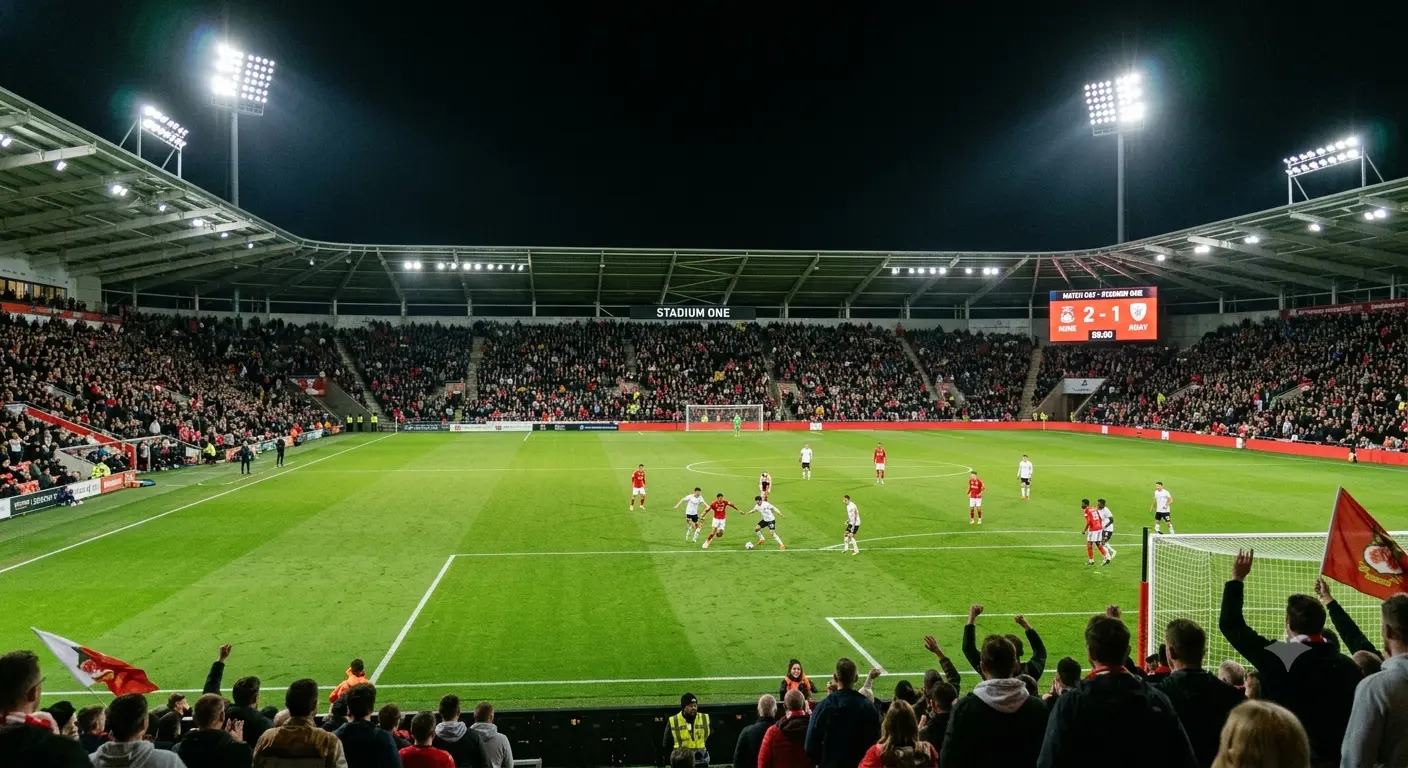
 A successful stadium design ensures both the pitch surface and the players' bodies are perfectly illuminated.
For Engineering, Procurement, and Construction (EPC) contractors bidding on international stadium projects, failing a photometric commissioning test is a costly nightmare. When municipal auditors or FIFA inspectors arrive to measure the pitch, they do not simply look at how bright the grass is. They measure light across multiple three-dimensional planes.
The most critical reason stadium lighting projects fail compliance is the inability to properly balance Horizontal and Vertical Illuminance. Focusing solely on a bright pitch will result in players looking like dark shadows on television.
In this technical guide, we will break down the physics behind these two vital metrics, explain why broadcasting cameras demand strict vertical lux, and detail how working with an expert sports lighting manufacturer ensures your LED Stadium Light layout achieves flawless certification.
1. The Core Physics of Stadium Illuminance
To understand why stadium lighting design is complex, we must separate light into two distinct planes of measurement.
1.1 What is Horizontal Illuminance (Eh)?
Horizontal Illuminance (Eh) measures the volume of luminous flux falling flat onto the ground. When a lux meter is placed directly on the turf facing the sky, it reads the Eh. This light allows players to see the ball at their feet, identify the pitch boundary lines, and provides the general bright "wash" across the stadium.
1.2 What is Vertical Illuminance (Ev)?
Vertical Illuminance (Ev) measures the light striking a vertical plane. During a FIFA or EN 12193 audit, the lux meter is elevated 1.5 meters off the ground (the average chest/face height of an athlete) and pointed toward the primary cameras and spectator stands. This metric ensures that the players' bodies and faces are clearly visible from a distance.
2. Why Broadcast Cameras Demand High Vertical Illuminance
 Television cameras capture light reflecting off vertical surfaces; without high Ev, players lose depth and detail.
If an EPC contractor is building a Class A or Class B stadium, television broadcasting is the primary driver of the lighting specification.
2.1 Preventing the "Silhouette Effect"
Cameras do not look straight down at the grass; they capture the action horizontally. If a lighting design uses fixtures that only shoot light straight down (high Eh, low Ev), the camera lens receives bright reflections from the grass, but the players themselves receive very little light on their faces.
This creates the "silhouette effect." The players appear as dark, featureless shadows against a glowing green pitch, ruining the broadcast quality and making facial recognition impossible for viewers and referees.
2.2 Meeting 4K/8K Ultra HD Broadcast Light Standards
Modern sporting events demand 4K/8K Ultra HD Broadcast Light capabilities. FIFA standards typically require a vertical illuminance of ≥ 1500 to 2000 lux facing the main camera. Furthermore, this light must possess excellent color rendering (CRI ≥ 90) to accurately capture team kits, and utilize flicker-free drivers to support high-speed slow-motion replays.
3. Balancing Eh and Ev: The Engineering Challenge
Increasing vertical illuminance sounds simple in theory: just tilt the stadium lights upward so they shine onto the players' faces. However, doing so introduces a severe optical penalty.
3.1 The Fatal Mistake: Tilted Fixtures and Glare
When standard symmetrical floodlights are tilted sharply to increase Ev, the raw LED diodes are exposed directly to the players and spectators. This causes a massive spike in the GR Glare Rating.
If a goalkeeper is blinded while tracking an incoming aerial ball, the lighting design has failed. FIFA mandates that the GR must remain below 50. Therefore, contractors cannot simply "aim high" to fix low vertical lux.
3.2 Calculating the Ideal Ev/Eh Ratio
Professional photometric design aims for a harmonious ratio between the two metrics. A healthy Ev/Eh ratio typically sits between 0.5 and 0.8.
This ratio provides excellent three-dimensional modeling. It ensures that athletes cast soft, manageable shadows rather than harsh, high-contrast silhouettes, allowing cameras to capture depth, speed, and spatial awareness accurately.
4. How EPC Contractors Guarantee Compliance
To achieve high Ev without violating glare restrictions, contractors must utilize advanced equipment and planning methodologies.
4.1 Using Asymmetric Optical Design for Precision
The ultimate engineering solution is the Asymmetric Optical Design. Instead of tilting the entire fixture housing up toward the sky, asymmetric lenses bend the light beam forward internally.
This allows the fixture face to remain parallel to the ground (reducing wind load on high mast poles) while projecting light at the necessary angle to bathe the players in vertical illuminance. The internal visors cut off stray high-angle light, securing a safe GR score.
4.2 Validating Bids with DIALux Lighting Simulations
Before finalizing a procurement order, EPC firms should require their sports lighting manufacturer to produce a comprehensive DIALux Lighting Simulation.
A professional DIALux report provides a 3D digital twin of the stadium. It calculates exact Eh and Ev grids, uniformity ratios, and glare statistics from every camera angle. Presenting this verified data within a tender proves absolute compliance and heavily de-risks the capital investment.
5. Conclusion
A world-class football stadium must serve the players on the pitch and the millions of fans watching on television. Relying solely on horizontal illuminance will result in dark, featureless broadcasts and failed commissioning audits.
By mastering the balance of Horizontal and Vertical Illuminance through asymmetric optics and comprehensive software simulations, EPC contractors can confidently deliver compliant, broadcast-ready arenas that pass strict FIFA inspections on the very first try.
Core Keywords: Horizontal and Vertical Illuminance, LED Stadium Light, 4K/8K Ultra HD Broadcast Light, DIALux Lighting Simulation, Asymmetric Optical Design, GR Glare Rating, Sports Lighting Manufacturer