
Designing indoor basketball court lighting presents a distinct set of physics challenges compared to outdoor field illumination. In enclosed arenas, light bounces off highly reflective polished wood floors, walls, and ceilings. For EPC contracting firms and electrical engineers, one of the most frustrating and common reasons an arena fails its technical commissioning is the presence of "double shadows"—or multiple overlapping shadows—cast by the players and the ball.
Multiple harsh shadows severely distort an athlete's depth perception, disrupt high-speed trajectory tracking, and ruin high-definition television broadcasts. Erasing these shadows requires more than just installing bright bulbs; it demands specifying high-performance LED sports luminaires with precise volumetric cross-illumination.
In this engineering guide, we dissect the optical causes of double shadows, analyze FIBA compliance standards for uniformity and UGR (Unified Glare Rating), and demonstrate how requesting a detailed DIALux lighting simulation from a professional manufacturer guarantees a flawless, broadcast-ready sports facility.
1. The Physics of Double Shadows in Indoor Arenas
To cure the double shadow phenomenon, we must first understand why standard industrial high-bays fail when applied to professional sports environments.
1.1 The Multi-Source Point Illumination Problem
Unlike sunlight (a single, infinitely distant light source that casts one distinct shadow), indoor arenas utilize dozens of individual LED fixtures. If these fixtures are installed directly overhead facing straight down—like typical warehouse lighting—a player standing in the center of the court will be struck by light from four or more different angles simultaneously.
Because these light beams do not properly intersect and blend, the player's body blocks light from multiple isolated points, projecting a "starburst" of 4 to 8 distinct, diverging shadows onto the hardwood floor.
1.2 Impact on Spatial Depth Perception and Broadcasts
For a basketball player, the shadow of the ball and opponents acts as a subconscious anchor for depth perception. When a ball casts three overlapping shadows, the brain struggles to calculate its true height and velocity. Furthermore, for HDTV broadcast cameras, heavy multi-directional shadows ruin the contrast ratio, making the footage look messy and unprofessional, ultimately failing FIBA Level 1 or 2 broadcast audits.
2. Engineering Solutions to Erase Shadows
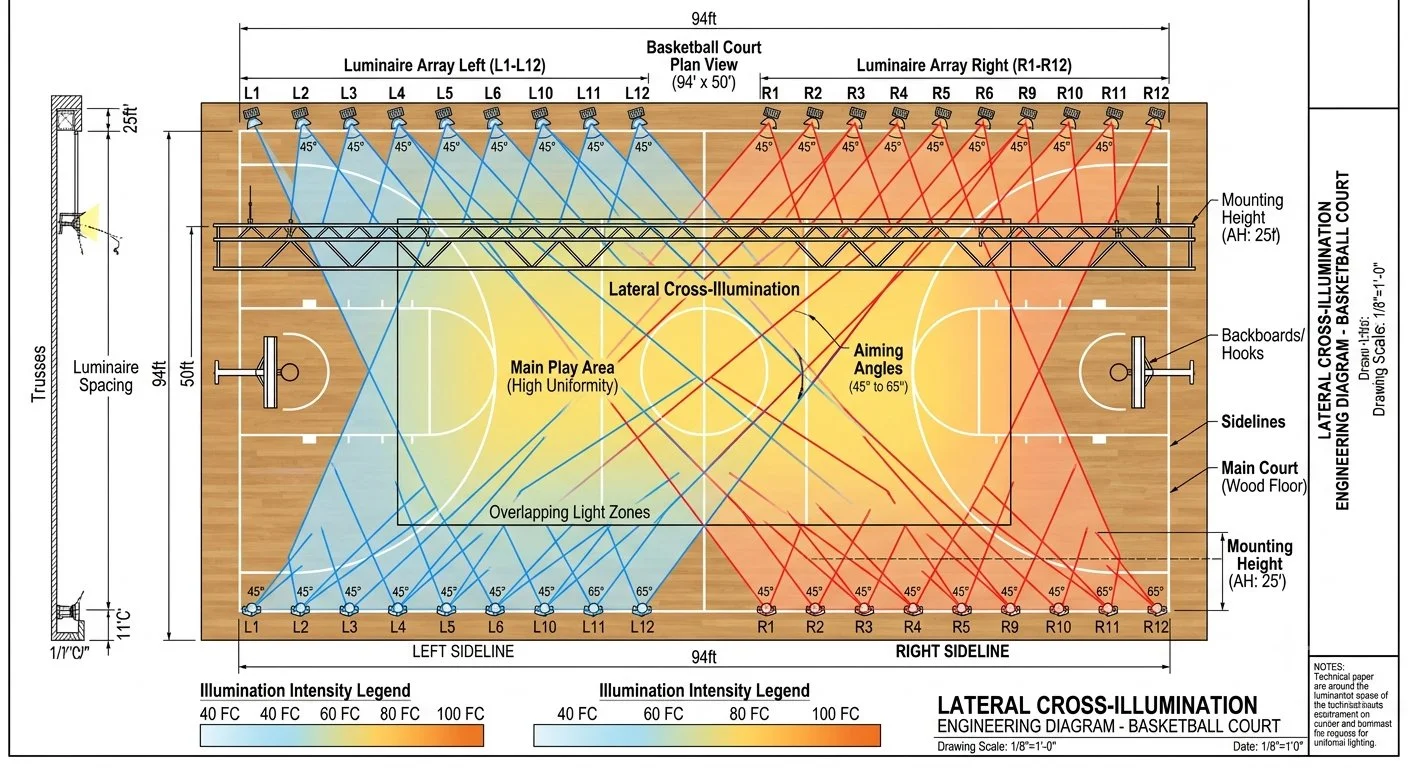 Cross-illumination from lateral catwalks allows opposing light beams to "fill in" and erase shadows cast by the players.
To eliminate double shadows, the lighting layout must shift from a "direct overhead" paradigm to a "volumetric fill" paradigm.
2.1 Bilateral Cross-Illumination Strategies
The most effective engineering technique is Lateral Cross-Illumination. Instead of mounting fixtures directly over the center of the court (which blinds players looking up for a rebound), fixtures are mounted on bilateral catwalks running parallel to the sidelines. The light from the left side projects diagonally across the court, and the light from the right side does the same.
When the shadow is cast by the left light array, the luminous flux from the right light array instantly "fills in" that dark space, effectively erasing the shadow and creating a soft, singular footprint.
2.2 Asymmetric Optics and Volumetric Lighting
To achieve perfect cross-illumination without tilting the fixtures at blinding angles, professional LED sports lights utilize Asymmetric Optical Lenses. These lenses internally shape the light into a wide, forward-throwing batwing distribution. This ensures that the light reaches the opposite side of the court evenly, maximizing horizontal uniformity (U1 ≥ 0.70) while maintaining the fixture housing parallel to the ceiling.
2.3 UGR Control and Maple Floor Reflectance Management
Indoor basketball courts typically use polished maple hardwood. This material has a high specular reflectance, acting almost like a mirror. If raw, high-intensity LEDs shine onto this wood, the glare bounces directly into the players' and cameras' lenses.
Therefore, controlling the Unified Glare Rating (UGR) is critical indoors. By utilizing frosted diffusers and internal anti-glare visors, engineers restrict the UGR to ≤ 22, softening the light to create a Lambertian reflectance off the floor, which further diffuses the shadows.
3. Photometric Standards & Compliance for Basketball
Eliminating shadows must be done while strictly adhering to official sporting body regulations.
3.1 FIBA and JGJ 153 Broadcast Standards
For an arena to host televised games, it must meet FIBA Level 1 or Level 2 (or JGJ 153 Class V/VI) standards. This requires a maintained horizontal illuminance (Eh) of ≥ 1500 to 2000 lux. However, the true test of shadow elimination is found in the uniformity requirements: U1 (Emin/Eavg) must be ≥ 0.70, and U2 (Emin/Emax) must be ≥ 0.80. These tight ratios guarantee an almost perfectly smooth light gradient across the hardwood.
3.2 Balancing Horizontal (Eh) and Vertical (Ev) Illuminance
To eliminate shadows on the athletes themselves, the lighting design must provide high Vertical Illuminance (Ev). If a court only has overhead lighting, players' faces and torsos fall into dark silhouette. By implementing the cross-illumination layout mentioned above, light strikes the players from multiple lateral angles, raising the Ev to ≥ 1000 lux toward the main TV cameras, ensuring pristine 4K/8K broadcast clarity.
4. DIALux Simulation and Risk Mitigation
 Advanced DIALux modeling visualizes shadow gradients and verifies UGR ratings prior to physical installation.
For EPC contractors, discovering double shadows after the fixtures are wired and mounted to the ceiling catwalks results in catastrophic financial delays. To mitigate this risk, a comprehensive DIALux 3D Lighting Simulation is mandatory.
This software calculates the exact photometric distribution, predicting the interaction of overlapping beams and the precise reflectance off the wooden floor. It proves to the venue owners that the proposed LED system will eliminate shadows and meet FIBA standards before a single purchase order is signed.
5. Conclusion
Eradicating distracting double shadows in an indoor basketball court is the hallmark of a professional lighting design. It requires abandoning outdated symmetrical high-bays in favor of lateral cross-illumination, asymmetric optics, and rigorous UGR glare control.
By integrating high-performance LED sports luminaires and backing your bids with verifiable DIALux data, EPC contractors can deliver flawless, broadcast-ready arenas that enhance athletic performance and guarantee project acceptance.
Core Keywords: indoor basketball court lighting, double shadows, LED sports luminaires, UGR control, FIBA lighting standards, DIALux simulation, sports lighting manufacturer