Contents
1. Start With the Pool Air, Not the IP Label
2. What an IP Rating Actually Covers
3. Why Chloramines Attack More Than the Housing
4. Specify a Corrosion System, Not One Material
5. Salt Spray Data: Useful, Not a Service-Life Promise
6. Optical and Thermal Design Still Matter
1.Start With the Pool Air, Not the IP Label

Picture an indoor pool after evening use. The deck is wet, the air is warm, and small droplets sit on the ceiling structure. A light fitting may look clean from the floor, yet its cable entries, screws, coating edges, and driver compartment are already working in a humid chemical environment. This is why indoor pool lighting should start with the air around the fitting, not an IP code alone.
Map ventilation, mounting height, cleaning, and maintenance access first. These details show where condensation persists and chlorinated air reaches fittings. In swimming pool lighting, weak environmental specifications create high maintenance.
2.What an IP Rating Actually Covers
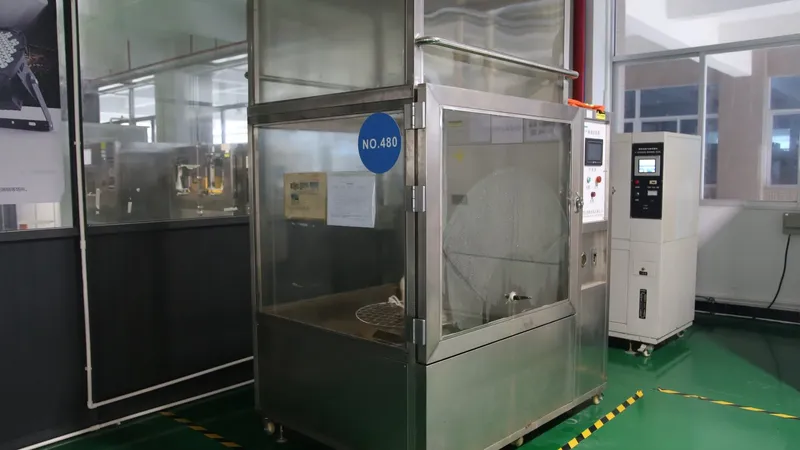
That site review gives the IP rating its proper role. IEC 60529 defines the IP Code as an enclosure classification for access, solid-object ingress, and water ingress. In an IP65 or IP66 label, the first digit 6 relates to dust ingress; the second digit describes the water test. Indoor pool lighting still needs a separate corrosion review. The CPS explainer on IP ratings for LED sports lighting gives a practical reading of this format.
An IP rating is important, but it does not grade chlorine tolerance, coating adhesion, galvanic corrosion, or cable-gland quality. It applies only to the tested enclosure configuration. The installation still needs suitable connectors, undamaged gaskets, correct torque, and cable entries that do not collect moisture.
3.Why Chloramines Attack More Than the Housing
The water test does not describe the pool atmosphere. The CDC explains that chloramines form when chlorine combines with bather waste. They can leave the water and build up in indoor air when ventilation is weak. This does not make every fitting fail, but it explains why a pool needs a different corrosion review from a dry sports hall.
Damage often begins at small interfaces. Moisture can stay under a washer, around a cable gland, at a powder-coat chip, or between dissimilar metals. The visible housing may remain acceptable while a screw head, bracket, gasket, or electrical connection degrades. A reliable indoor swimming pool lighting specification treats corrosion resistance as an assembly requirement, not a housing-material claim.
4.Specify a Corrosion System, Not One Material
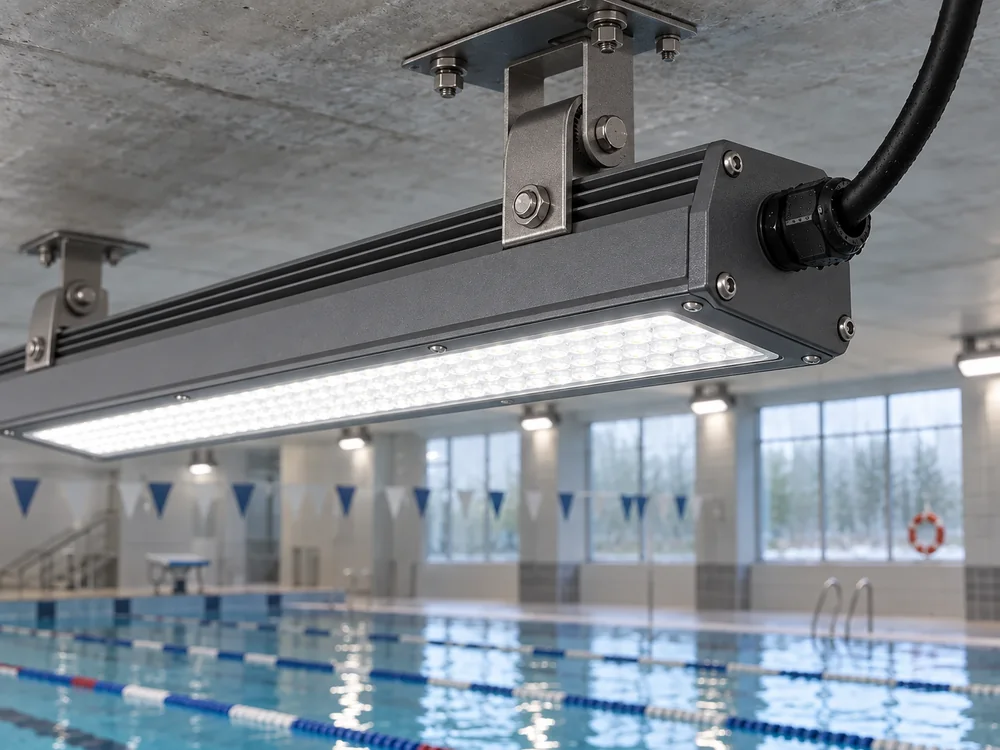
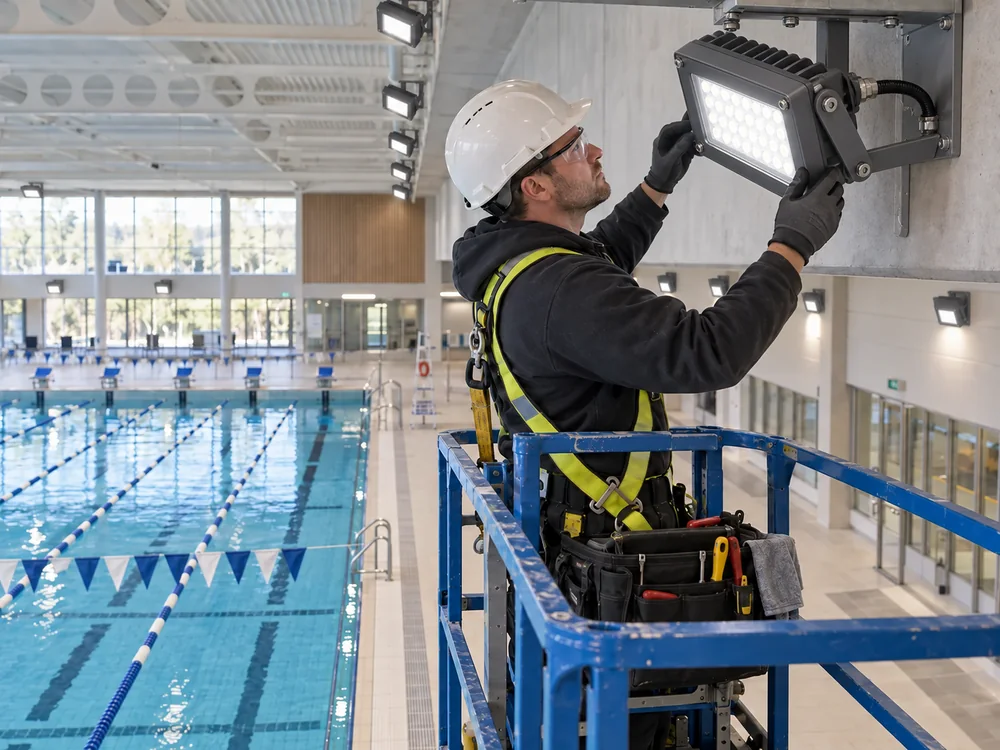
This is where procurement should become more specific. Ask for the housing alloy, surface preparation, coating system, stainless grade for exposed hardware, gasket material, cable-gland rating, lens material, and pressure-equalisation method. The review should also identify dissimilar-metal contacts and describe how the mounting bracket isolates or protects them.
A supplier datasheet may report IP66, but the project team should confirm that the supplied bracket, connector, visor, and cable entry match the tested configuration. The Dubhe Projection Light 200W lists IP66 and a pressure valve. These are useful inputs, yet they do not replace a pool-specific compatibility review. This is the difference between a catalog selection and corrosion-resistant pool lights specified for a real site.
5.Salt Spray Data: Useful, Not a Service-Life Promise
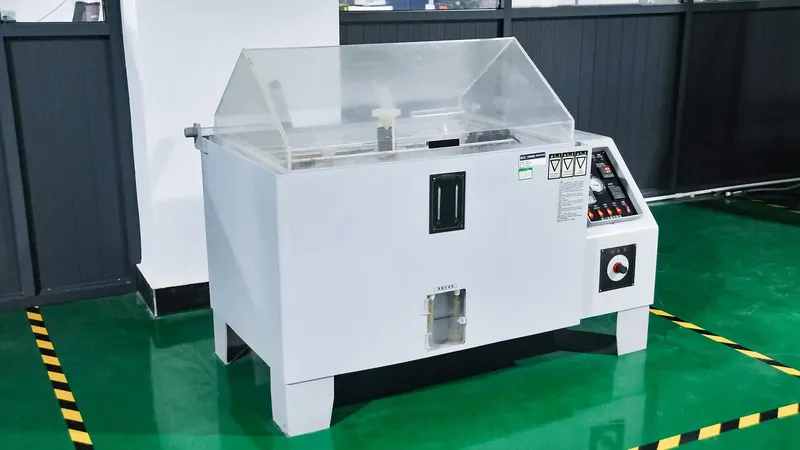
The next check is test evidence. ISO 9227 describes neutral salt spray and related tests for assessing corrosion resistance or finding coating discontinuities. The standard also states that these tests are not intended to predict long-term corrosion resistance or rank materials. A high-hour result is therefore useful quality evidence, but it is not a guaranteed number of pool-service years.
Ask what was tested: a coated coupon, a bare component, or the full assembled luminaire. Then ask for the duration, acceptance criteria, photographs, and the exact coating and fastener configuration. The CPS note on luminaire salt-spray testing is a useful starting point for that conversation. The project decision should still reflect ventilation, cleaning chemistry, and mounting exposure.
6.Optical and Thermal Design Still Matter
Environmental durability is only one part of the job. Water reflects bright sources, so poor aiming can create veiling reflections for swimmers, lifeguards, and cameras. The indoor pool lighting design should assess horizontal and vertical light, uniformity, reflections, and glare control from deck and pool viewpoints. The CPS guide to GR and UGR glare ratings explains why a lux value alone is not enough.
Thermal design also needs attention. A sealed enclosure protects internal parts, but the driver and LED board still need a path to reject heat. Designers should review ambient temperature near the roof, operating schedule, control mode, and clearance around the heat sink. Software such as DIALux or AGi32 can test the optical plan before installation, while product testing and commissioning confirm the finished system.
7.Case Evidence and Acceptance Workflow
A practical retrofit shows why the full workflow matters. The CPS Case Center lists a Grade II indoor swimming-pool lighting retrofit at Tianjin University’s Beiyangyuan Campus Natatorium. The published project summary describes a 3,000 m², 10-lane, 50 m pool where the original average illuminance was below 100 lx and glare from water reflections was a problem. This is useful swimming pool lighting evidence, not a universal target.
For a new project, set a written acceptance plan before purchase. It should include approved luminaire configuration, IP report, corrosion-test evidence, structural fixing details, photometric file, aiming schedule, light-meter grid, and close-up inspection of glands and gaskets. The final commissioning report should record readings, photographs, control scenes, and any changes made on site. That record gives the facility team a basis for future inspection and maintenance.
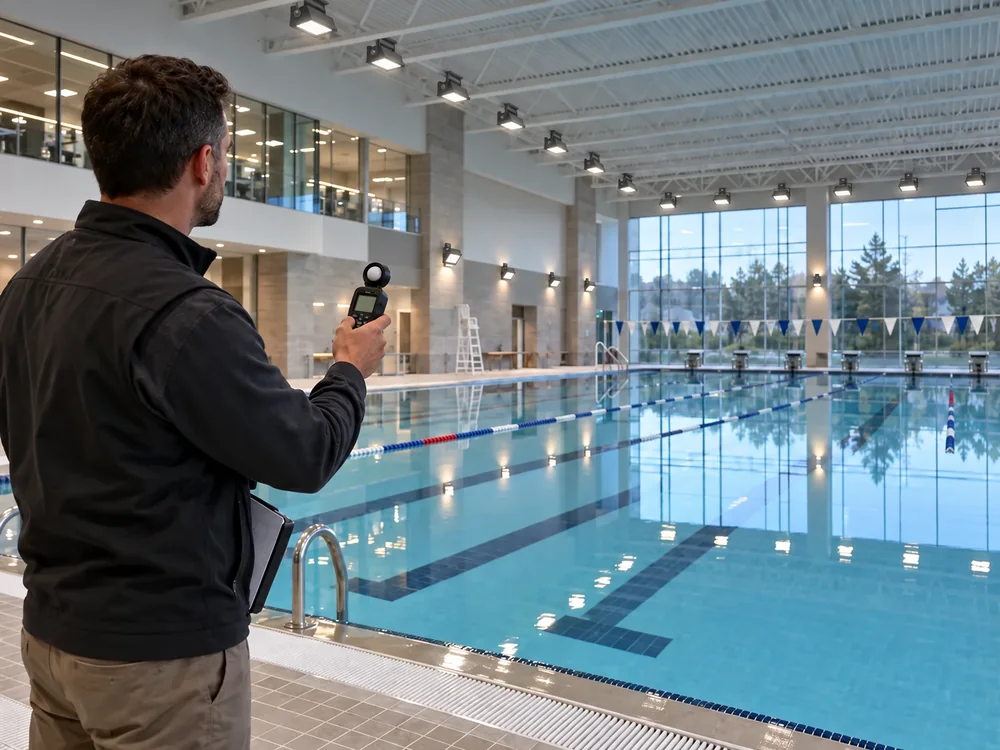
The key point is simple. An IP label protects against defined ingress tests. A dependable indoor pool lighting installation needs that protection plus compatible materials, sealed interfaces, good optics, thermal control, ventilation, and documented inspection. When these parts are specified together, LED pool lights are easier to maintain and more likely to keep their intended performance.
8.Technical Sources
IEC 60529: Degrees of protection provided by enclosures (IP Code)
ISO 9227: Corrosion tests in artificial atmospheres — Salt spray tests
Keywords
indoor pool lighting, swimming pool lights, IP65 lighting, IP66 lighting, corrosion-resistant pool lights, chloramine resistance, LED pool lights, pool lighting design, glare control, lighting uniformity, salt spray testing, aquatic center lighting