
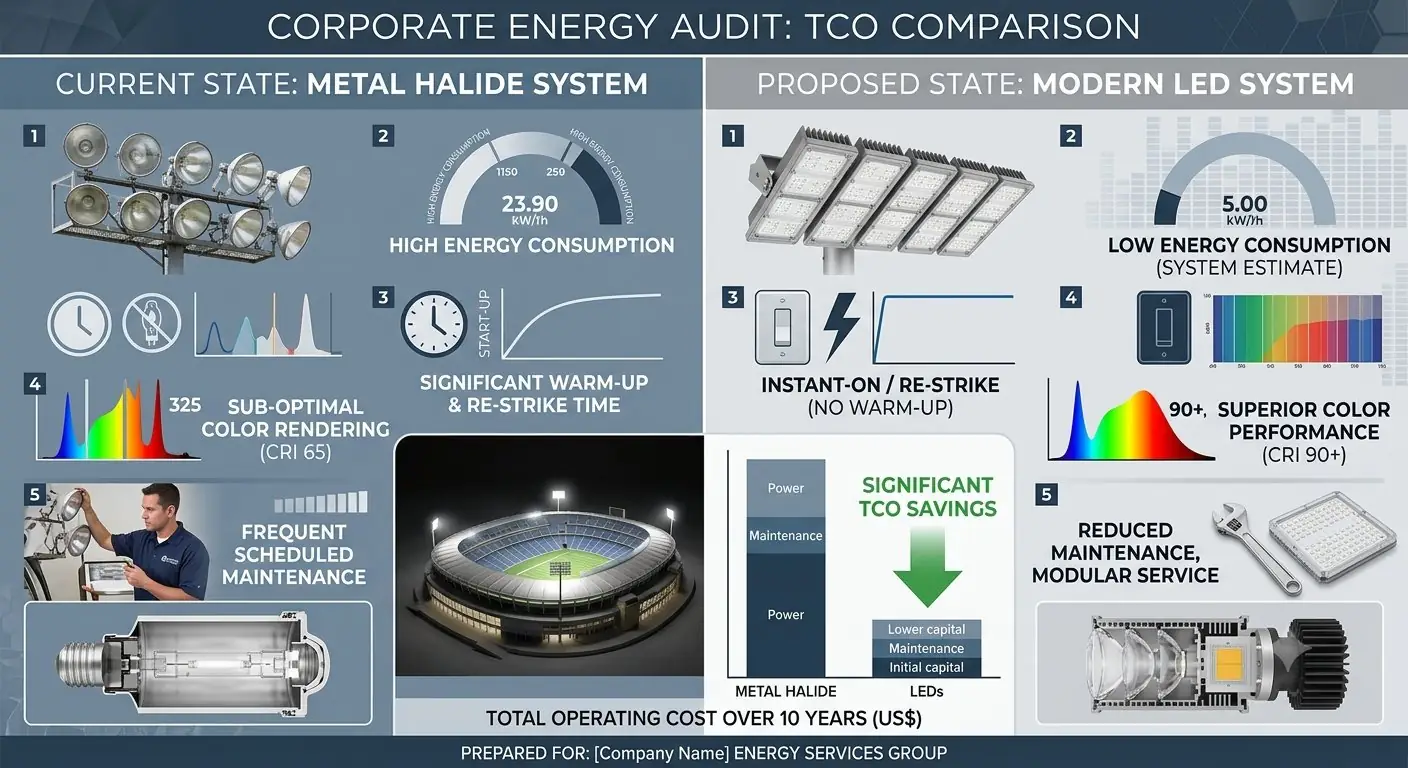
 Upgrading old sports infrastructure requires more than swapping lamps
When municipal authorities or stadium owners decide to upgrade aging sports facilities, the initial instinct is often financial: "Can we simply swap out the old metal halide bulbs for new LED modules on existing poles?" For international Engineering, Procurement, and Construction (EPC) firms, answering this question requires a deep understanding of photometric engineering.
A simple 1-to-1 LED bulb replacement without analyzing light distribution is one of the fastest ways to fail a stadium commissioning test. LEDs behave fundamentally differently than legacy HID sources, making professional optical planning non-negotiable.
In this technical guide, we will break down why direct retrofitting fails, how different Light Distribution Types interact with legacy high mast poles, and how partnering with an experienced sports lighting manufacturer ensures a successful Turnkey Lighting Project.
1. The Physics Problem: Why Direct LED Retrofitting Fails
At first glance, screwing a high-lumen LED retrofit bulb into an old metal halide housing sounds like an economical shortcut. However, lighting physics makes this approach a recipe for disaster on professional sports pitches.
1.1 Omnidirectional HID vs. Directional LED Diodes
Legacy Metal Halide (MH) and High-Pressure Sodium (HPS) lamps are omnidirectional—they emit light in a 360-degree sphere. Old floodlight housings rely heavily on large, polished aluminum reflectors to bounce and shape that raw light toward the playing field.
By contrast, Light Emitting Diodes (LEDs) are strictly directional point sources. When you install an LED retrofit bulb into a legacy reflector housing, the optical interaction breaks down completely. The light no longer bounces off the reflector as intended; instead, it creates uncontrolled hot spots, massive light spill, and severe glare for players and spectators.
1.2 The Collapse of Uniformity and Uniformity Ratios
FIFA, EN 12193, and regional sports standards mandate strict horizontal and vertical uniformity ratios (U1 and U2). When old fixtures are clumsily retrofitted with mismatched LED sources, the light beam pattern deforms.
Instead of an even wash of light across the turf, the pitch will exhibit severe striping, dark patches in the center circle, and blinding hot spots near the touchlines. This structural failure in light distribution inevitably causes the stadium to fail its post-installation commissioning audit.
2. Mastering Light Distribution Types in Stadium Upgrades
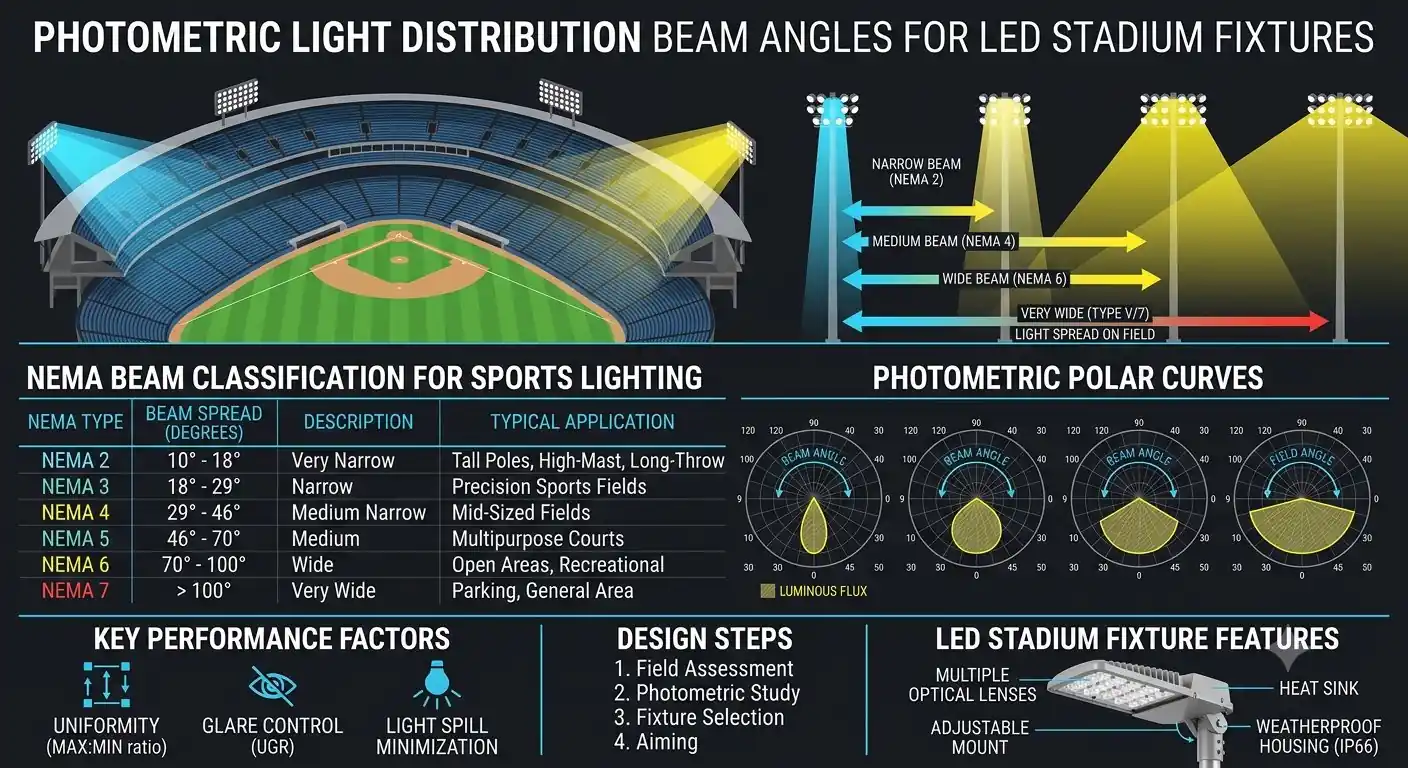
 Selecting correct beam angles ensures proper light overlap between high mast poles without causing light trespass.
A professional stadium upgrade requires replacing entire legacy luminaires with purpose-built LED Stadium Light systems engineered with precise optical control.
2.1 Narrow, Medium, and Wide Beam Angles Explained
Different zones of a sports pitch require completely different optical distributions:
Narrow Beams (Spot): Used on high-mast towers located far back from the pitch to throw intense light all the way to the opposite side of the field.
Medium Beams: Used to illuminate the middle zones and flanks of the playing surface, ensuring smooth transitions.
Wide Beams (Flood): Positioned closer to the pitch or on lower architectural structures to wash the near-side grass evenly.
2.2 How Asymmetric Optical Designs Protect Against Glare
Old metal halide fixtures often required steep tilting angles to throw light onto the far side of the pitch, causing blinding glare for players looking up.
Modern retrofit strategies rely heavily on Asymmetric Optical Design. These specialized lenses project light forward in a batwing distribution while keeping the fixture housing completely parallel to the ground. This drastically lowers the GR Glare Rating while maximizing target turf illuminance.
3. Engineering Solutions for Legacy High Mast Poles
When retrofitting an old stadium, EPC contractors must work within the structural constraints of existing infrastructure. You cannot simply mount heavier lights onto legacy poles without structural calculations.
3.1 Calculating Wind Loads and Structural Weight Limits
Legacy metal halide fixtures were bulky and heavy. While high-power LEDs are lighter, their surface area and windage (Effective Projected Area - EPA) must be meticulously checked against the fatigue limits of old high mast sports light poles. Selecting modular, aerodynamic LED fixtures prevents excessive wind torque during storms.
3.2 Thermal Management in Enclosed Retrofit Fixtures
LEDs are sensitive to heat. If a retrofit fixture lacks proper thermal dissipation, internal temperatures will skyrocket, leading to premature diode degradation. Professional retrofit luminaires incorporate robust Die-cast Aluminum Heat Sinks that channel heat away from the chips, ensuring a 50,000+ hour operational lifespan in harsh outdoor environments.
4. The Engineering Workflow: From Simulation to Commissioning
Successful stadium retrofits rely on a strict, data-driven engineering workflow rather than guesswork.
4.1 Leveraging DIALux Lighting Simulations for Bid Success
Before submitting a bid, EPC contractors should collaborate with a qualified sports lighting manufacturer to run an advanced DIALux Lighting Simulation.
The simulation models the exact coordinates of existing legacy poles, tests various optical beam angles, and outputs precise horizontal/vertical lux grids. Providing this simulation report in your tender proves to stadium owners that your retrofit solution will meet or exceed international standards without risking expensive trial-and-error adjustments.
5. Conclusion
Retrofitting old sports stadiums with LED technology offers immense energy savings and superior performance, but it cannot be treated as a simple bulb-swapping exercise. Ignoring light distribution results in glaring hot spots, uneven pitch uniformity, and failed commissioning tests.
By utilizing asymmetric optical designs, calculating legacy high-mast structural limits, and backing every bid with professional DIALux simulations, international EPC contractors can secure tenders and deliver flawless, high-performance LED upgrades.
Core Keywords: LED Stadium Light, Light Distribution Types, Asymmetric Optical Design, Retrofitting Old Stadiums, DIALux Lighting Simulation, High Mast Sports Light, Sports Lighting Manufacturer