
Engineering a track and field venue presents a unique challenge for international contractors and EPC procurement managers. Unlike standard rectangular fields, a 400-meter running oval demands highly precise optical control to prevent overlapping shadows and blind spots across all lanes. Partnering with a proven sports lighting manufacturer ensures your project meets international bidding requirements while delivering a safe, visually uniform environment for competitive events.
Achieving a blind-spot-free layout requires a balance of horizontal uniformity, vertical illuminance, and glare restriction. Properly configured optics protect athletes from visual fatigue while meeting high-definition television broadcast standards.
In this technical analysis, we will examine the engineering parameters of professional athletics lighting, breakdown World Athletics and EN 12193 standards, and detail how to optimize your high-mast layouts to secure municipal approvals and long-term performance. Let us explore the technical specifications of athletic lighting design.
1 Why Standard Stadium Solutions Fall Short
 High Mast Sports Lighting System Installed Around A Multi-Lane Running Track Demonstrating Asymmetric Distribution
1.1 Spatial Challenges of the 400m Running Oval
Standard sports pitches, such as soccer fields, feature a rectangular footprint. This allows engineers to use symmetric, predictable lighting distributions. In contrast, a 400-meter running track is a complex layout composed of straightaways and curves.
Longitudinal Straightaways: These sections require broad, parallel light beams to maintain visual continuity across all lanes.
Parabolic Curve Zones: These areas demand precise, targeted angles. As runners change direction, the incident angle of light changes relative to their field of vision, which can create shadows or sudden glare spikes if not properly managed.
1.2 Uniformity Across Running Lanes: Eliminating Inner-Lane Shadowing
Shadows are a common problem on multi-lane athletic tracks, particularly in Lanes 1 and 2 (the innermost lanes). This issue often arises when fixtures are optimized solely for the central turf or field area. High-performance projects require an Integrated Stadium Light layout that carefully balances overlap.
To eliminate overlapping shadows, the lighting design must maintain a horizontal uniformity ratio (U1 = Min/Avg or U2 = Min/Max) above 0.5 to 0.7, depending on the venue's competition level. This ensures there are no dark patches between the light beams.
1.3 Balancing Horizontal and Vertical Illuminance (Eh vs. Ev)
Designing athletic lighting requires a careful balance between two primary metrics:
Eh (Horizontal Illuminance) + Ev (Vertical Illuminance) = Multi-Angle Visual Performance
Horizontal illuminance (Eh) provides light on the track surface itself, helping runners clearly see lane boundaries and ground markings. Vertical illuminance (Ev), measured at 1.5 meters above the ground, lights up the bodies of the runners. This is critical for judges, spectators, and broadcast cameras to track motion and capture details like finish-line photos. For more insights on how these metrics apply to multi-use venues, read our guide to types of stadium lighting.
2 Compliance Standards and Optical Quality Criteria for Athletics Arenas
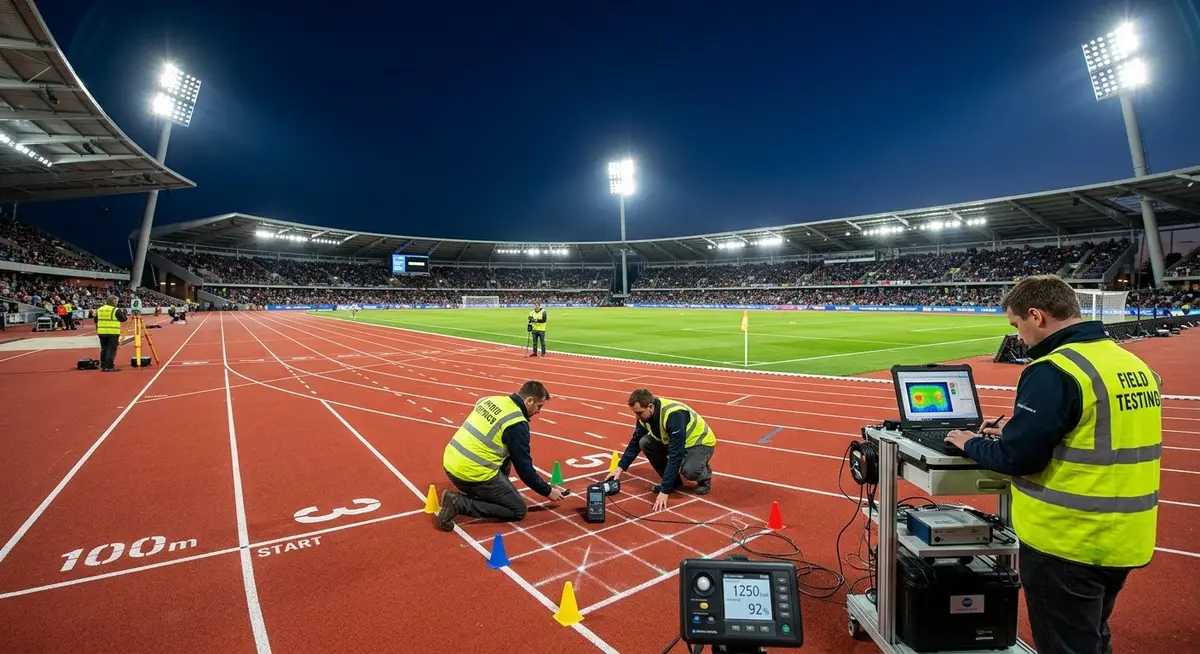 Photometric Evaluation Performance Testing Of Integrated Stadium Lighting On Athletics Track
Quick Reference Table: Athletics Lighting Specifications (EN 12193 & World Athletics Standards)

Understanding these standardized parameters helps contractors align project scope with budgetary allocations while ensuring compliance during on-site testing.
2.1 World Athletics (IAAF) & EN 12193 Classifications
For public bidding and municipal projects, specifications are typically governed by World Athletics or the European standard EN 12193. These bodies divide athletics lighting into three tiers of competition.
Class I (Elite Competition): Requires high lux levels (typically ≥ 500 lux for general play, scaling to over 1000 lux for broadcasts) with strict uniformity control to support high speeds and critical officiating.
Class II (Regional Competition): Requires a target of 200 lux with moderate uniformity, designed for regional tournaments and advanced training centers.
Class III (Recreation & Training): Requires a minimum average of 100 lux, providing a cost-effective solution for local schools and public recreation.
2.2 Managing GR Glare Ratings on Curve Zones
Excessive glare is a major safety hazard for runners coming off a curve. It can temporarily obscure visual reference points, which can lead to lane infractions or injury. In professional lighting designs, the GR Glare Rating is kept at or below 50.
Meeting this rating is achieved by using precision internal optics, physical visors, and carefully calculated aiming angles. This directs light downward onto the running surface while minimizing the lateral light spill that causes glare.
2.3 HD TV Broadcast Requirements: CRI, TLCI, and Flicker-Free Controls
For high-level venues, the lighting must support both human vision and digital broadcast equipment. Standard LEDs can create a flicker effect on camera. Under high-speed slow-motion replay (such as a photo-finish camera operating at thousands of frames per second), this flicker can make footage unusable.
Professional athletic fixtures integrate a high-frequency, flicker-free power supply (ripple coefficient ≤ 1%). This is combined with a Color Rendering Index (CRI) of ≥ 90 and a Television Lighting Consistency Index (TLCI) of ≥ 85 to ensure accurate, vibrant color reproduction for television audiences. For more information, explore our technical breakdown of lumens and efficiency parameters.
3 Structural and Photometric Engineering for Bidding Projects
 Engineering Detail of High Mast LED Light Tower Construction on Athletics Ground Site
3.1 Asymmetric Light Distribution and Patented Optical Designs
In high mast applications, symmetrical lighting forces engineers to tilt fixtures at steep angles, which can increase glare and waste energy through light spill. Advanced sports lighting designs use an asymmetric forward-throw beam pattern.
Utilizing a Patented Optical Design allows the light engine to throw light forward onto the track surface while keeping the physical face of the fixture parallel to the ground. This minimizes wind resistance and reduces glare.
3.2 Thermal Dissipation and Wind-Resistance Systems
High mast sports lights operate in harsh outdoor conditions, requiring robust mechanical and thermal engineering. Heat is the primary cause of LED lumen depreciation over time.
Heavy-duty luminaires feature a die-cast aluminum heat sink with open convective paths to keep junction temperatures low. This helps ensure a stable lifespan exceeding 50,000 hours (L70). Additionally, because these fixtures are mounted on tall poles (typically 15 to 45 meters), they are designed to withstand local wind loads (typically rated up to 50 m/s or 17 on the Beaufort scale). This helps protect the structural integrity of the high mast assembly.
3.3 Executing Detailed DIALux Lighting Simulations
To minimize project risk, contractors should always request a detailed DIALux lighting simulation before purchasing equipment. A comprehensive layout plan includes:
Exact Pole Positioning: Coordinates that prevent structural interference with runways, landing pits, and stands.
Luminance Grid Calculations: Point-by-point horizontal and vertical lux values across the track and field areas.
Aiming Angles and Orientation Charts: Clear directions for on-site installers to adjust each fixture during commissioning, reducing installation time.
Review our technical guide to light distribution types to learn how different optical distributions improve overall field uniformity.
4 EPC Project Procurement and Safety Qualifications
For international engineering companies bidding on public infrastructure tenders, component quality and safety certifications are essential criteria for bid compliance.
4.1 Global Product Certifications: CE, UL, CB, and SAA Standards
Procuring compliant fixtures helps protect contractors from liability and potential project delays. High-performance sports lighting installations should carry recognized certifications:
CE Certification: Complies with European safety, health, and environmental standards.
UL Certification: Verifies compliance with North American electrical safety standards.
CB Scheme: Eases the process of obtaining national certifications across more than 50 participating countries.
SAA Certification: Meets Australian and New Zealand electrical safety and performance requirements.
4.2 IP66/IP67 Ingress Protection and Corrosion Resistance
Outdoor sports venues expose fixtures to heavy rain, dust, and temperature swings. To ensure reliable performance over a long service life, high-wattage sports fixtures require robust environmental protection.
Specifying IP66 or IP67 rated systems helps prevent water and dust from degrading the internal electronics. Additionally, housing materials with C4/C5 marine-grade anti-corrosion coatings are recommended for coastal areas to resist oxidation from salt air.
For technical guidelines on industrial and outdoor municipal infrastructure lighting, refer to our comprehensive overview of outdoor lighting classifications.
5 Conclusion: Minimizing Risk in High-Performance Sports Lighting
Designing a track and field lighting system involves more than just selecting high-wattage fixtures. It requires precise optical control, structural integrity, and compliance with global athletic standards. Working with a dedicated sports lighting partner helps ensure a balanced, reliable installation.
As you plan your next athletic facility project, ensure your procurement pipeline addresses both structural specifications and certified photometric accuracy to deliver guaranteed compliance from day one.
As you plan your next major bidding project, keep these key technical targets in mind:
Prioritize asymmetrical, forward-throw optics to prevent shadows in the inner lanes.
Ensure the system maintains high-definition TV capabilities, including flicker-free performance and high CRI/TLCI metrics.
Verify that all fixtures carry the necessary global safety certifications, such as CE, UL, CB, and SAA.
A robust, well-simulated layout ensures complete lane coverage, long-term durability, and safe, consistent visual conditions for competitive events. Partnering with experienced professionals helps bring confidence and quality to your next athletic project.
Core Keywords: track and field lighting, high mast sports light, sports lighting manufacturer, sports lighting supplier, DIALux lighting simulation, Integrated Stadium Light, EN 12193