
 A Category I athletics stadium lit by four-corner high-mast LED arrays delivering broadcast-grade uniformity
When municipal owners and EPC contracting firms tender a new athletics venue, they frequently default to a single headline number—average lux—and treat every standard the same. That assumption collapses the moment a project is measured against track and field lighting requirements set by World Athletics.
World Athletics governs the world’s elite competitions, and its illuminance, illuminance uniformity and glare ceilings sit above generic recreational norms because the venue must serve high-speed photography, photo-finish judging, and global broadcast simultaneously.
In this engineering guide we decode the World Athletics framework, map its illumination classes to concrete EPC design values, and explain how specifying the right sports lighting manufacturer protects your handover from compliance disputes.
1. The World Athletics Regulatory Framework
World Athletics (the body formerly known as the IAAF) publishes its venue technical requirements across two complementary documents: the Competition Rules, which define what a certified event demands, and the Facilities Manual, which sets the permanent infrastructure baseline. For lighting, both converge on the same physics—but the manual is the document an EPC team cites at design sign-off.
1.1 Competition Rules vs. Facilities Manual
The Competition Rules are event-specific and may impose temporary upgrades (for example, additional broadcast vertical lux) for a championship. The Facilities Manual specifies the permanent installed system. A venue built only to the training tier of the manual cannot be upgraded to Category I by swapping lamps; the pole geometry, aiming, and optical distribution are fixed at construction.
1.2 Why WA Thresholds Exceed Generic EN 12193
EN 12193 is a sound European baseline, but World Athletics adds stricter constraints for elite tracks because of finish-line photoelectric timing, hawk-eye, and multi-camera broadcast. Where EN 12193 Class I might accept a U1 of 0.60, WA Category I typically demands 0.70 or higher on the track to keep the photo-finish camera’s reference marks unambiguous.
2. Illuminance Classes for Track and Field
World Athletics classifies venues into tiers—commonly read by EPC teams as Category I (international / global broadcast), Category II (continental / regional TV), Category III (club / training with limited spectators), and Category IV (community recreation). Each tier maps to a target average horizontal illuminance (Eh) and a vertical illuminance (Ev) budget.
 Point-by-point lux grid used to verify World Athletics uniformity (U1/U2) on track and infield.
2.1 Horizontal Illuminance (Eh) Targets by Class
Typical design targets: Category I ≈ 2000 lx average on infield and track; Category II ≈ 1000–1500 lx; Category III ≈ 500 lx; Category IV ≈ 200–300 lx. These are installed (initial) values before the maintenance factor; the design must add headroom for lumen depreciation and surface dirt (LLF ≈ 0.75–0.85).
2.2 Vertical Illuminance (Ev) for Broadcast
Broadcast turns the requirement vertical. Camera-facing vertical illuminance (Ev) should reach roughly 1400–2000 lx for Category I, with Ev,min / Ev,avg ≥ 0.50 and a controlled horizontal-to-vertical ratio (typically 0.5–2.0) so players’ faces and the ball read cleanly on slow-motion replay.
2.3 Emergency and Egress Minimums
Beyond competition lux, WA-aligned venues must keep safe egress lighting (often ≥ 10–20 lx on circulation routes, sustained for the required duration) and a backup that prevents total blackout during timing or evacuation. EPC packages should treat this as a separate circuit with its own UPS or generator transfer.
3. Uniformity and Glare Requirements
Average lux is meaningless if the track has bright corridors and dark bends. World Athletics enforces two uniformity ratios and a glare ceiling that together define “playable” light.
3.1 U1 / U2 Ratios on Track and Infield
U1 = Emin / Eavg and U2 = Emin / Emax. For Category I track and infield, design to U1 ≥ 0.70 and U2 ≥ 0.60. Low U1 means a runner crosses a visible brightness step at every lane change; low U2 means hot spots that blind incoming throwers. Asymmetric optics and careful aiming are what push these ratios up, not raw wattage.
3.2 Glare Rating (GR) Ceilings
Glare Rating (GR) quantifies discomfort for athletes looking toward the floodlights. WA Category I/II typically cap GR at ≤ 50; lower categories may allow ≤ 55. Achieving low GR on a high-mast layout means shielding, precise cut-off, and keeping luminaires out of the direct upward sightline of sprinters in the starting blocks.
3.3 Color Rendering (Ra, R9) and CCT
For elite venues, general color rendering Ra ≥ 90 (≥ 80 minimum) with saturated-red R9 ≥ 50 so jersey numbers and lane markings stay legible on camera. Correlated color temperature is commonly 4000–5700K; broadcast-heavy venues favor ≈ 5600K to match other camera feeds. A mismatch in CCT between poles reads as patchy color on the worldwide feed.
4. Measurement Grids and Field Verification
A compliant design is not compliant until it is measured. World Athletics references a defined grid of calculation and verification points; the EPC team models it in software, then confirms it on site.
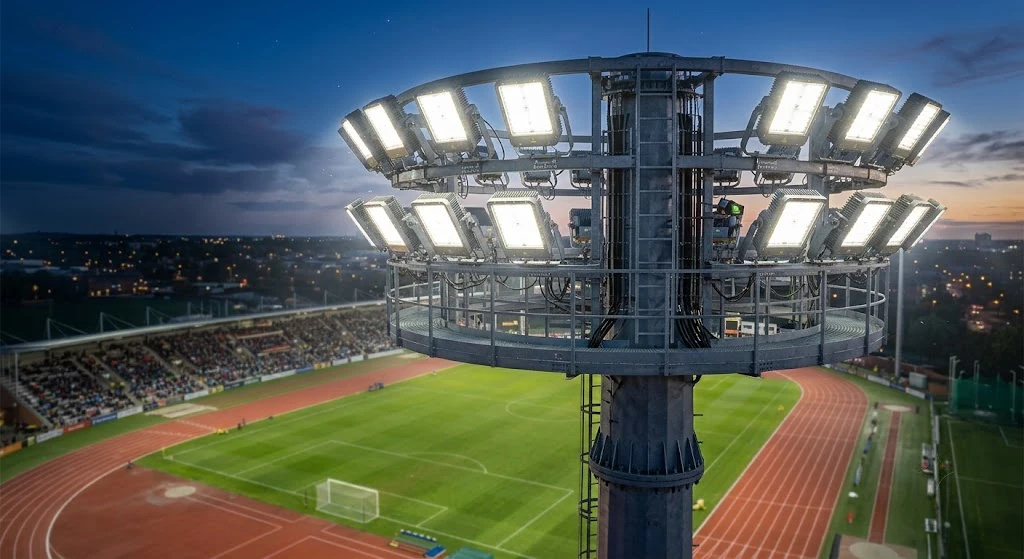 High-mast luminous arrays engineered for anti-sway and a low glare rating (GR).
4.1 WA Point Grid for a 400 m Track
Standard 400 m tracks have 8 lanes (≈ 1.22 m each) plus an infield. Verification grids sample every lane centroid and the infield on a spacing (commonly 5–10 m) dense enough to catch local dips. The finish-line straight and the throwing sectors get tighter sampling because that is where timing and safety cameras concentrate.
4.2 DIALux Modeling vs. As-Built Commissioning
DIALux (or equivalent) simulation proves the design before a single pole is poured; as-built commissioning proves the installed system after. Expect divergence from dust, pole plumb error, and optic tolerance—so design with margin and re-aim on site. A good sports lighting supplier delivers both the model file and the post-install lux map.
5. EPC Delivery: Design, Poles, and Controls
Translating the standard into a buildable package means fixing pole positions, selecting luminaires, and specifying controls that let one venue serve training nights and continental finals.
Pole geometry: four-corner high-mast (or side-runner) layouts dominate; mast height, throw distance, and aiming define whether U1/U2 and GR are achievable. Wind and anti-sway matter—an oscillating mast smears the photometric result and the broadcast image.
Controls: zoned dimming lets the operator drop to Category III for daily training and ramp to Category I for events, cutting energy and extending luminaire life while staying inside the standard’s envelope.
Handover: the deliverable is not “lights that turn on” but a documented package—design lux map, as-built lux map, uniformity and GR calculations, and the commissioning certificate—so the owner’s WA certification audit passes first time.
Key Takeaways
World Athletics tiers (Category I–IV) map directly to target average lux, uniformity, and glare limits—design to the highest tier the venue will ever host.
Uniformity (U1 ≥ 0.70, U2 ≥ 0.60 for Cat I) and GR ≤ 50 are won with optics and aiming, not with more watts.
Broadcast demands vertical illuminance (Ev) and tight color (Ra ≥ 90, R9 ≥ 50, ≈ 5600K), verified by an as-built lux map.
Handover packages must include design + as-built photometry and a commissioning certificate for WA compliance.
Core keywords: world athletics lighting, track and field lighting, illuminance uniformity, glare rating, vertical illuminance, DIALux simulation, high-mast lighting, LED stadium lights, sports lighting manufacturer.