Contents
1. Why the Hoop Area Can Become a Dark Zone
2. Geometry Controls Light at the Basket
3. Measure More Than Floor Lux
1.Why the Hoop Area Can Become a Dark Zone

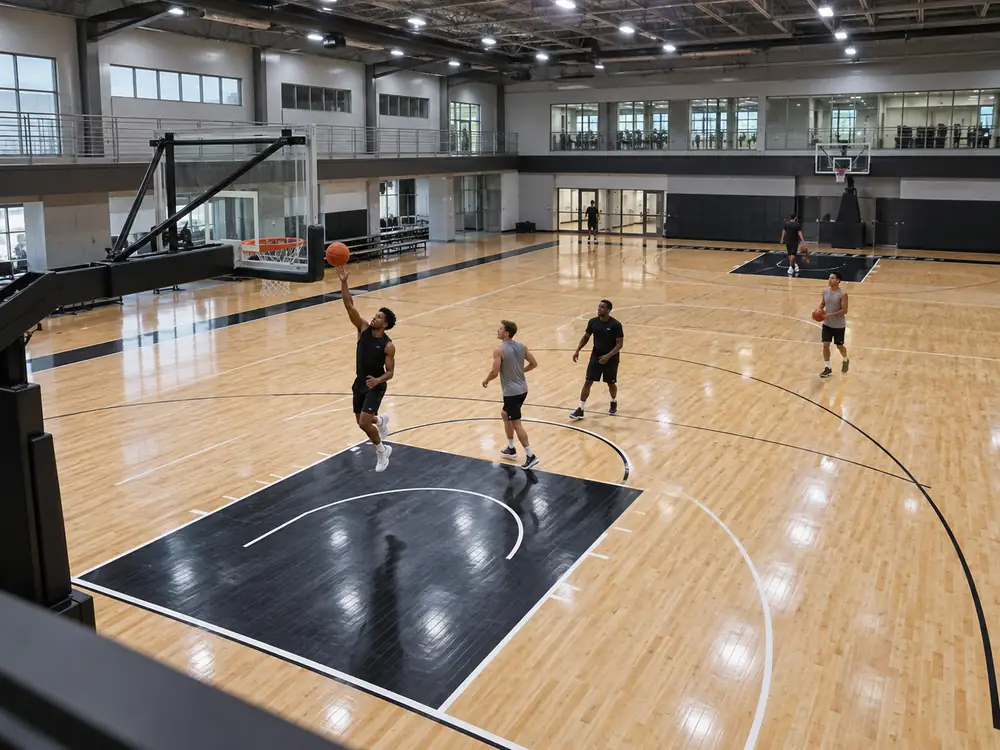
A basketball arena can look bright from the stands and still leave the hoop area weak. This often appears at the baseline, directly below the backboard, or on the near side of the painted key. A player then sees a darker ball, a flat rim, or a strong shadow from the backboard support. The issue is not simply low basketball court lighting. It is poor distribution at a visually demanding part of the game.
Consider a fast drive from the wing. The player needs to judge the rim, the defender’s hands, and the ball near the glass. A camera also needs vertical light on faces and jerseys. This is why an arena layout must check the basket as a three-dimensional zone rather than treating it as a small patch of floor.
2.Geometry Controls Light at the Basket
Roof trusses, scoreboard structures, backboard supports, and low mounting heights can interrupt a beam before it reaches the rim. A row that works over centre court may create a shadow at each end because the light arrives at a shallow angle. Designers should place luminaires between courts where a multi-court hall allows it, then use beam widths and aiming groups that overlap at the free-throw lane and backboard plane.
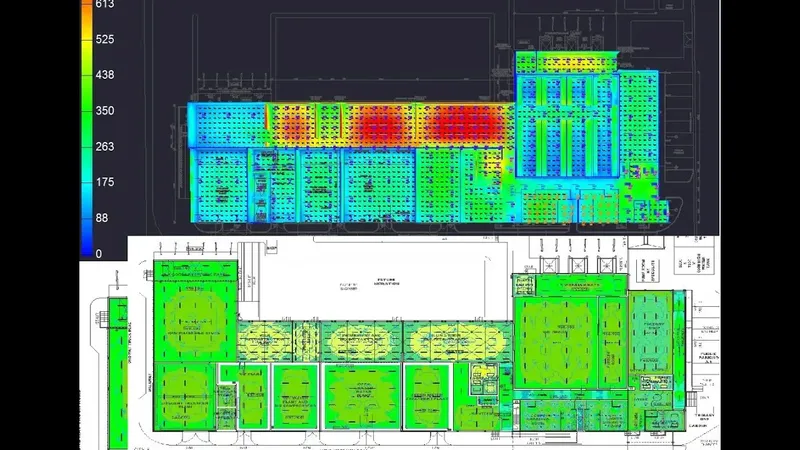
The FIBA playing-area method is useful because it separates the 19 m × 32 m Principal Playing Area from the 22 m × 35 m Total Playing Area. This stops a design from ignoring the bench-side and end-zone edges. The CPS DIALux and AGi32 guide explains how verified photometric files can reveal these weak points before a fixture is installed.
3.Measure More Than Floor Lux
Horizontal illuminance, or Eh, checks light on the floor. It does not show whether the front of the rim, a player’s face, or the ball in the air has enough light. Vertical illuminance, Ev, and main-camera illuminance, Ec, matter more for a broadcast arena. FIBA’s current high-level reference for the PPA uses Ec 2,000 lx, Ev 1,700 lx, and Eh 1,500–3,000 lx, with uniformity limits as well.
Those values serve major FIBA competition and broadcast needs, not every school gym. Still, the principle applies at every level: use the required class, then test average light, minimum light, and the gradient near each basket. The CPS horizontal and vertical illuminance article gives a useful explanation of the two measurement planes.
4.Layout Options Compared
5.Test the Hoop Area Before Handover
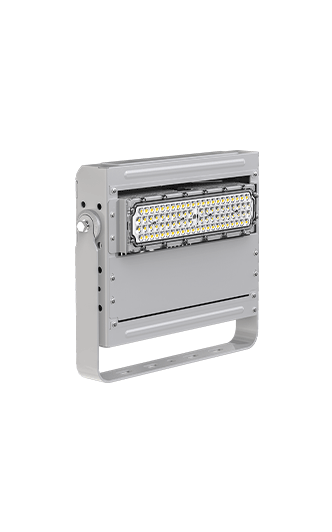
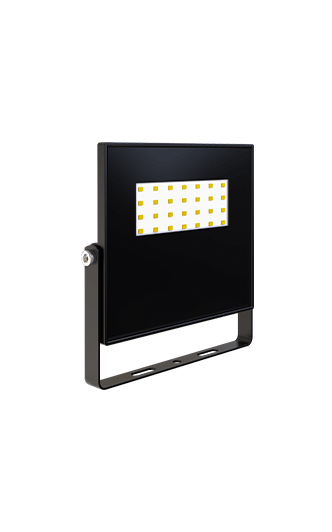
The final check should include floor readings, vertical measurements toward camera directions, a view from the free-throw line, and a visual inspection during real shooting. Review flicker and reflection on glossy floor lines too. The Polaris LED Flood Light TS-BJX can provide a suitable platform, but the selected optic and aiming schedule decide the result.
A balanced hoop area gives players better depth judgement, gives officials a clearer view, and gives cameras stable contrast. The best indoor basketball lighting design treats both baskets as first-order calculation targets from the start.