Contents
1. Start With the Real Baseball Brief
2. Why the Infield and Outfield Differ
3. Read Illuminance Numbers Correctly
1.Start With the Real Baseball Brief

Picture a night game where a ground ball moves across the infield and a fly ball then rises into deep centre field. The players do not perform one visual task. An infielder reads a fast ball, base edges, and another player at close range. An outfielder needs to find a small white ball against a dark sky, while turning and running. This is why baseball field lighting divides the infield and outfield instead of applying one lux number everywhere.
The phrase “MLB lighting standard” can be misleading. Major League ballparks use venue-specific design briefs, broadcast requirements, local codes, and owner standards. A public project should therefore state its competition level and broadcast need first. In North America, ANSI/IES RP-6 is a key technical reference for the design process, field measurement, glare, and sports-specific lighting guidance.
2.Why the Infield and Outfield Differ
The infield is compact and carries repeated high-speed decisions. The pitcher, batter, catcher, bases, and foul lines need stable contrast. It normally receives more horizontal illuminance and tighter uniformity. The outfield covers a larger and less regular area. It still needs enough light for running, catching, and warning-track awareness, but its grid and optics must extend farther without putting bright floodlights in a fielder’s sightline.
The difference is not permission to leave the outfield dark. It is a controlled hierarchy. A bright infield paired with a patchy outfield makes a high fly ball harder to track. A balanced LED sports lighting layout uses cross-light from several directions, overlaps beams at the zone boundary, and checks the foul territory, bullpen, and wall separately.
3.Read Illuminance Numbers Correctly
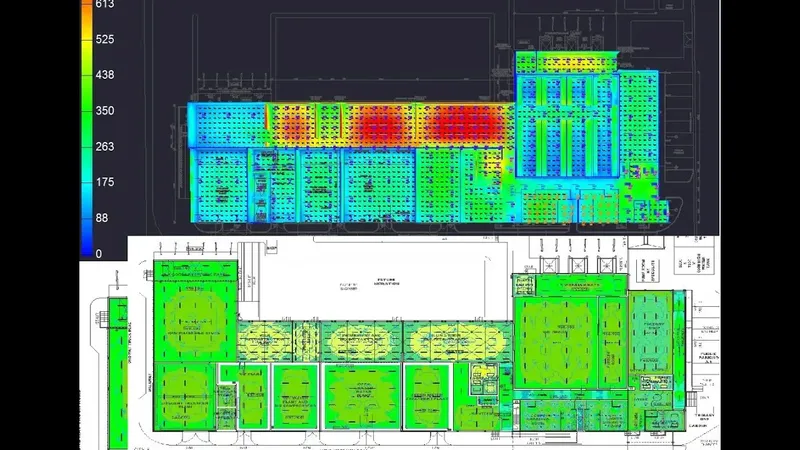
A maintained value already allows for expected light loss during service. It is not the same as the first-night reading. The widely cited Class IV reference below shows why the two zones differ. It is a concept-stage comparison only. A professional or broadcast project needs its own approved brief and calculation model.
The important calculation is not just average Eh. Engineers should review max:min or coefficient-of-variation targets, point locations, and the maintained photometric file. A project also needs enough overlap at the grass-to-dirt transition. The CPS guide to horizontal and vertical illuminance explains why a ground-plane result does not describe every real viewing task.
4.Add Vertical Light and Glare Control
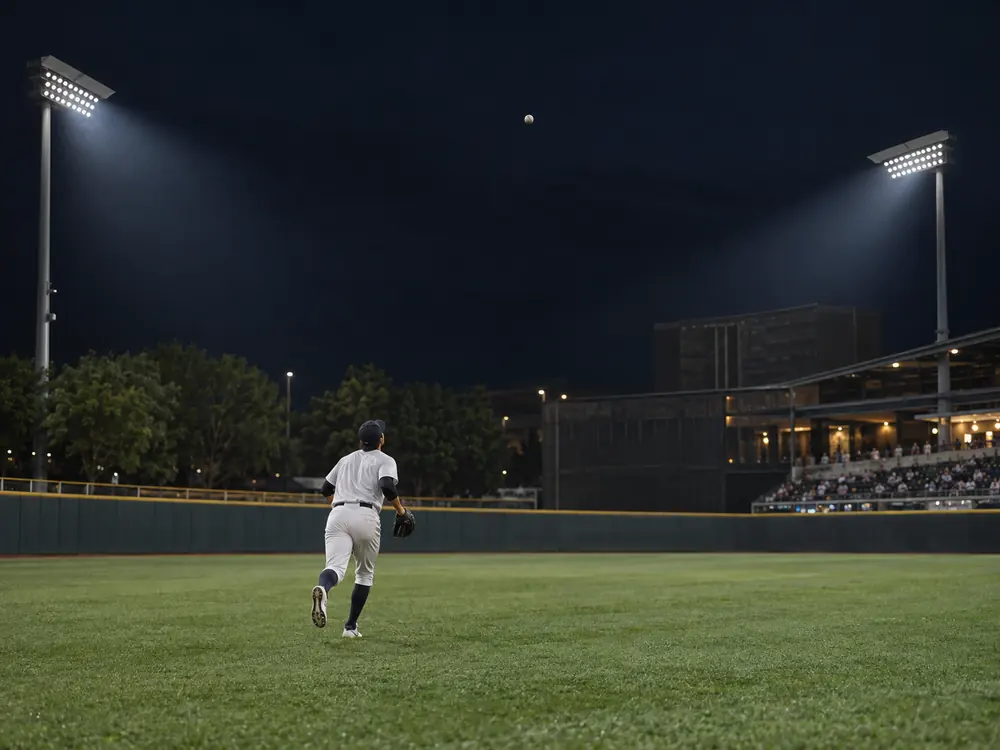
A ball in flight is not on the ground plane. Vertical illuminance helps describe light reaching a player, a ball, or a camera direction. Designers should calculate relevant vertical planes and then inspect the ball path visually. More flux cannot correct a poor aiming direction. The best result keeps the LED source outside critical views while placing useful light through the likely flight space.
This is also a glare control problem. Shields, asymmetric optics, mounting height, and pole placement work as one system. The CPS explanation of GR and UGR glare ratings in sports lighting is useful background, but a baseball design still needs player-specific sightline checks from home plate, the mound, and the outfield.
Camera work adds another view. A design that looks acceptable from a spectator seat can still create a bright source behind a centre-field camera or uneven faces in the batter’s box. The lighting calculation should therefore include the required camera directions before the aiming schedule is fixed.
5.Model, Aim, and Commission
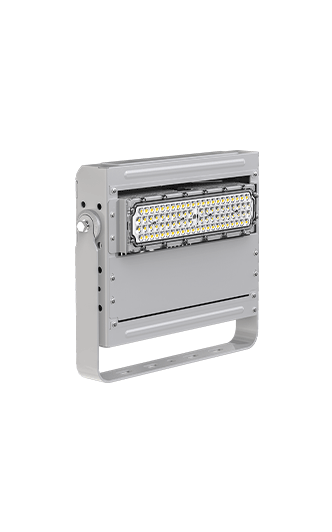
A reliable workflow starts with field dimensions, pole setbacks, fence height, camera positions, and adjacent property. The team should import verified IES or LDT files into DIALux or AGi32, calculate the infield and outfield grids separately, and test vertical planes before procurement. Product power is only one variable. Optics, aiming, and the installed mast geometry decide whether a Polaris LED Flood Light TS-BJX or another sports floodlight is suitable.
After installation, measure the approved grid with calibrated meters, check aiming angles, and walk the critical sightlines. Record the settings before handover. Good baseball stadium lighting gives the infield priority without sacrificing outfield visibility, player comfort, or the people living beyond the fence.
6.Technical Sources
Illuminating Engineering Society: ANSI/IES RP-6-22
Keywords
MLB baseball lighting standards, baseball field lighting, infield illuminance, outfield illuminance, LED sports lighting, vertical illuminance, glare control, lighting uniformity, baseball stadium lighting, DIALux lighting simulation